
Most companies believe that phone communication is a simple thing. The phone rings, someone answers, the issue gets handled, and the business moves on. In reality, it is often much messier. When a customer calls, the sales team may be in a meeting, administration may be buried in documentation, and support may already be focused on existing requests. In that moment, one missed call can turn into a much bigger problem than it seems at first.
Behind every unanswered call there may be a potential customer, an existing client with a problem, a business partner, a job candidate, or a person ready to make a buying decision right away. When there is no system that can accept, process, and route that contact properly, the company does not lose only one conversation. It loses a sales opportunity, a better support outcome, or the chance to build a long-term business relationship.
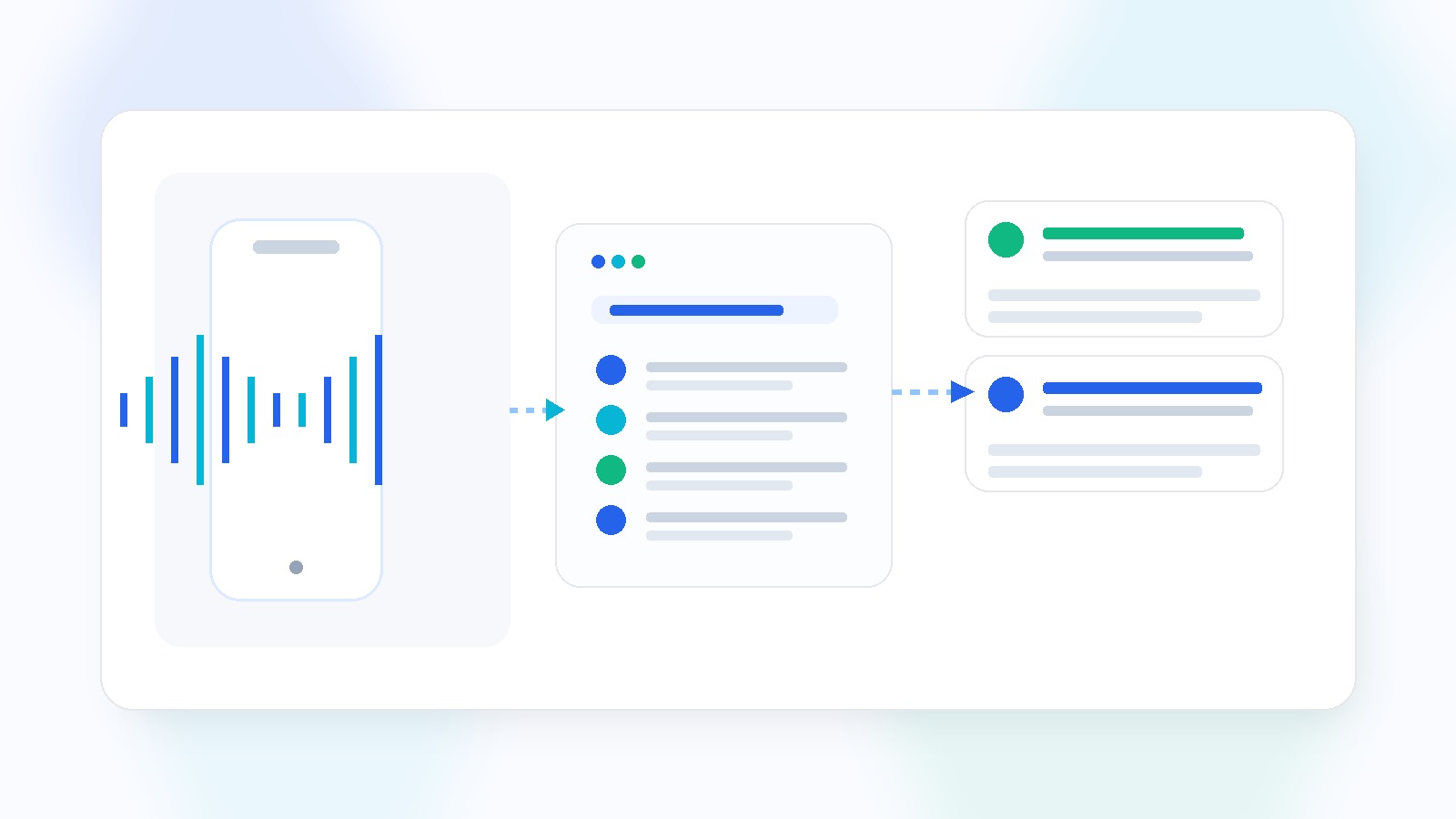
That is why an AI voice agent becomes much more than another technology trend. Its role is not to imitate a receptionist or hold random conversations. Its job is to turn every inbound call into an organized business process: recognize the caller's intent, collect the relevant information, store it, and route it to the right team or employee. That way, no request is left behind in memory, on a sticky note, or in a list of missed calls.
An AI voice agent is not the same as a classic voice menu
Many people still confuse AI voice agents with the traditional phone menu systems that have existed for decades. Most of us have gone through the endless experience of ?press 1 for sales,? ?press 2 for support,? or ?press 3 for information.? Those systems work through predefined rules and do not understand what the user is actually trying to say.
An AI voice agent works on a completely different principle. Instead of forcing the caller through rigid choices, it listens to natural speech, analyzes the conversation, and tries to understand the real intent of the person calling. If important details are missing, it asks follow-up questions, gathers the necessary data, and organizes everything into a clear and usable format.
That is a huge difference for any company. It is not enough for an employee to receive a vague message such as ?someone called about an offer.? It is necessary to know who called, which product or service they care about, how urgent the request is, whether they are already an existing client, and who inside the organization should handle the case next. Without that, request handling becomes guesswork instead of a real process.
The real problem is not the missed call, but the chaos that follows
When companies talk about phone communication, they usually focus only on the number of missed calls. But in many cases, an even bigger issue appears in what happens after someone does answer.
An employee listens, writes down part of the information, tries to remember the rest, and promises to pass the request to the right person. Then another task arrives, another meeting starts, or another phone call interrupts the flow. Some details are lost, some remain unclear, and some are simply forgotten.
The result is familiar to almost every customer. The client has to call again, explain the same situation again, spend more time, and become frustrated. Employees then try to reconstruct who spoke with the customer last, and a simple request turns into an unnecessarily complicated process that drains time, energy, and the company's reputation.
An AI voice agent solves exactly that problem because it does not treat the phone conversation as an isolated event. It treats it as the beginning of a business process. If someone is calling about an offer, the conversation can automatically become a sales lead. If it is a complaint, it can become a support ticket. If the customer wants to book an appointment, the system can trigger the reservation flow. The information remains recorded and available to the team that continues the communication, just as described in processes that continue after the conversation ends.
Where an AI voice agent creates the most value
The biggest impact comes in companies that process a large number of similar requests every day. These do not have to be giant corporations with hundreds of call center employees. It is enough that there is a steady flow of repeated questions and recurring call scenarios.
These may include inquiries about opening hours, order status, product availability, service pricing, appointment scheduling, required documentation, delivery timelines, or complaint procedures. When employees answer the same questions every day, a large share of their time goes into routine work that creates very little additional value.
That is exactly where an AI voice agent can take over the first level of communication, collect the necessary information, and free people to focus on the more complex tasks that require expertise, judgment, or decision-making.
That is why these systems work especially well in medical organizations, service centers, e-commerce companies, logistics, insurance, education, agencies, real estate, and any environment where a missed call directly affects revenue or customer satisfaction.
What a high-quality AI voice process looks like
One of the most common misconceptions is that a good AI voice agent must conduct complicated and impressive conversations. In reality, its value is measured much more simply.
A quality agent should introduce itself, understand the reason for the call, collect the basic details, estimate urgency, explain the next step to the caller, and pass the information to the right person or system. Its goal is not to impress the user with complex language. Its goal is to produce a clear and useful outcome from every conversation.
If, after the conversation, the company receives a precisely recorded request with the caller's name, contact details, reason for calling, priority, and a suggested next action, then the system has done its job well. That is far more valuable than an agent that sounds natural but leaves no practical result behind.
Voice agents and chatbots work better together
Companies often ask whether they need a chatbot or a voice agent more. In practice, those two tools should not be treated as competitors.
Modern users communicate through many channels. Someone may first visit the website and ask a question through chat. Someone else may immediately pick up the phone and call. A third person may send a message or an email. For the user, these are not separate communication systems. They are simply trying to get an answer.
That is why the best results appear when a website chatbot and an AI voice agent share the same knowledge base and the same business processes. Whether the user communicates through the website or the phone, the question is handled in the same way, the information is stored, and the team gets the full communication context.
This approach allows a company to build a single and controlled entry point for all customer requests, regardless of the channel through which they arrived.
What must be prepared before implementation
Successful AI voice agent implementation does not begin with technology. It begins with business process analysis. The first step is identifying the most common reasons people call. In most cases, analyzing ten to twenty typical scenarios is enough to cover the majority of inbound calls.
After that, the company needs to organize its knowledge base and gather the information the agent can use during the conversation. This includes data about services, opening hours, pricing, procedures, business rules, locations, and the most common customer questions.
It is equally important to define clear project goals. Does the company want to reduce missed calls? Speed up request handling? Increase the number of qualified leads? Reduce the workload on support? Without concrete goals, it is difficult to assess success and measure real return on investment.
The biggest mistake is giving AI complete freedom
Many people believe that an AI agent will be more successful if it is allowed to answer everything it knows. In practice, the opposite tends to be true.
Like any serious business system, an AI voice agent needs clearly defined boundaries. It is necessary to specify which information it may provide, when it should ask follow-up questions, in which situations it must involve a human operator, and when it should openly admit that it does not have the answer.
These limits are not a weakness. They are the foundation of reliability. Users do not expect the agent to know everything. They expect accurate information and a clear next step. That is what builds trust and a strong customer experience.
Why this topic also matters for SEO
People searching for phrases such as ?AI voice agent,? ?phone call automation,? ?virtual support agent,? or ?AI agent for calls? usually already have a concrete business problem. Their organization may be receiving too many calls, the team may be overloaded, or too many requests may be left unresolved.
That is why good content on this topic should not be only a technical feature description. It is much more useful to explain real business challenges, show concrete use cases, and demonstrate how these problems are solved in practice.
When an article connects the problem a business owner feels every day with a solution they can understand and apply, both the reader and the search engine benefit. Visitors stay longer, find relevant information more easily, and build trust in the company offering the solution.
An AI voice agent is not designed to replace people or fully take over customer communication. Its greatest value lies in bringing order where chaos most often starts: at the very beginning of communication.
When every call is received, recorded properly, classified, and routed to the right person, the company stops losing requests, potential customers, and valuable employee time. Instead of phones being a source of stress and uncertainty, they become an organized channel where every contact has a clear path and a concrete outcome.
In a world where users expect fast answers and constant availability, an AI voice agent becomes an important part of modern business infrastructure. Not because it replaces people, but because it enables them to work in a more efficient, organized, and focused way on the activities that create the greatest value for the company.